

On the podcast: Own The Build Leadership Series
Own the Build Leadership Series Podcast
I'm appearing on the Own The Build Leadership Series podcast, out 28 September.
Paul Heming, Co-Founder and CEO at C-Link and the host of the Own the Build Podcast, got in touch after a LinkedIn post I wrote on procurement, following our first Constructing Excellence Hampshire event. The conversation ended up going well beyond procurement: my route from wanting to be an accountant to running a QS team at Ridge, and what changed the day I had to stop doing project work myself.
One line has stuck with me since prepping for it. The real test of leadership is whether you're creating people who eventually don't need you. I've watched that happen with someone on my own team over the past few years, and looking back, I don't think I planned it as deliberately as it might seem.
We also get into procurement, because I couldn't resist. My honest view was that construction talks endlessly about collaboration, then writes contracts that reward the opposite. Clients want certainty. Contractors need to protect margin. Consultants sit under fee pressure. None of that is unreasonable on its own but put it all together and everyone behaves exactly as the commercial model tells them to. It's the same thread running through what we're trying to do with Constructing Excellence Hampshire.
The episode goes live 28 September on Spotify, Apple Podcasts and YouTube.
Too many tenders are still pricing uncertainty, not certainty, Hampshire construction leaders warn
Are we still procuring projects the wrong way?
Choosing the wrong procurement route, or choosing the right one too late, can be enough to sink a construction project before it starts, senior industry figures agreed at a gathering in Southampton this week.
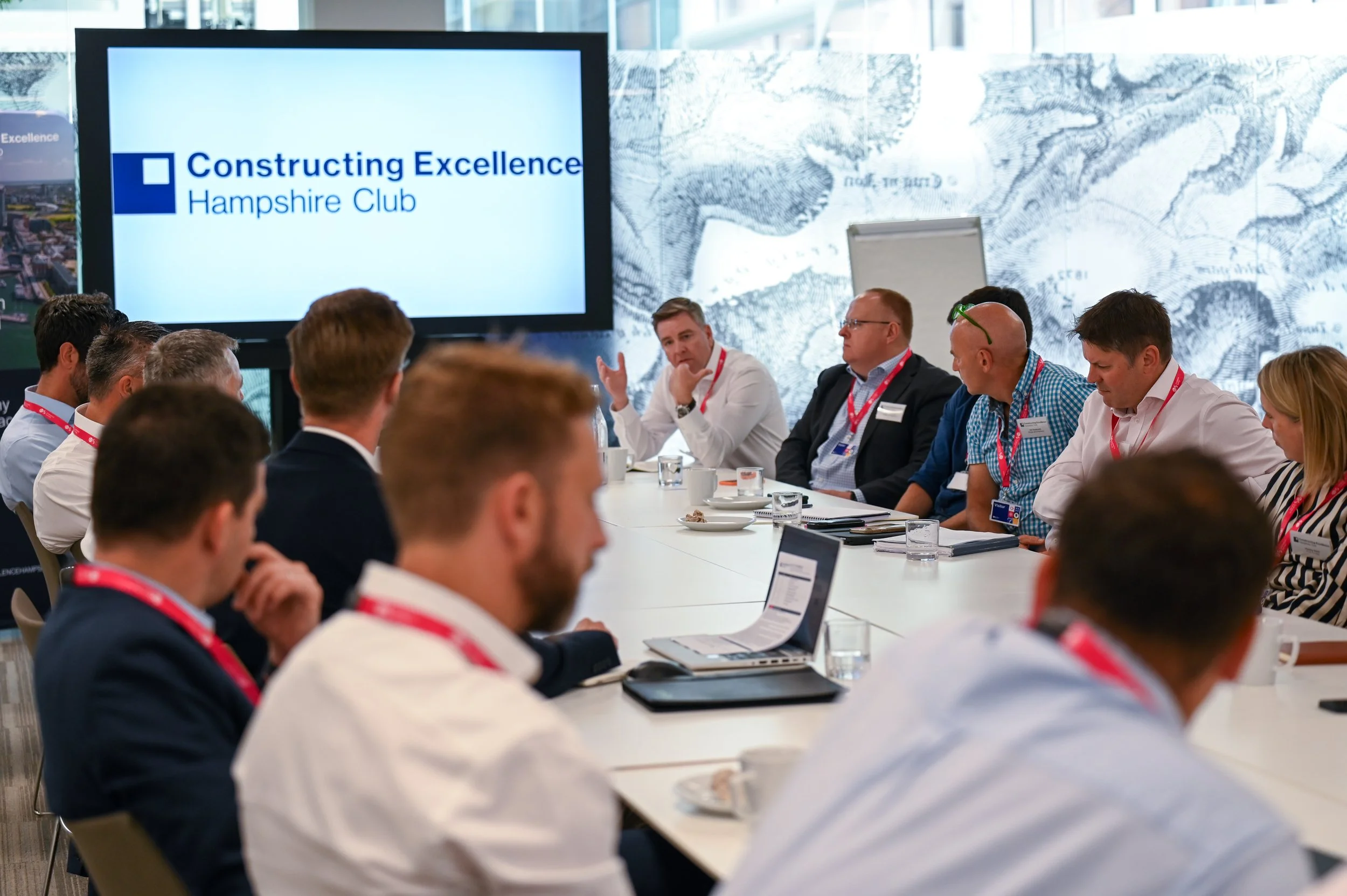
More than 30 construction leaders attended the second Constructing Excellence Hampshire session, held on Thursday 9 July at Ordnance Survey's Explorer House. The audience included local authorities, contractors, consultants, developers and legal advisers from across the county, with Jonathan Solly of Ridge and Partners, who chairs the group, leading the discussion.
The format mirrored the first session: three short provocations, this time from a consultant, a contractor and a client, followed by open roundtable discussion, no slides, no scripts. Drew Vince of AECOM, Mike Hedges of Beard Construction and Ola Onabajo of Southampton City Council set up the conversation, then handed it to the room.
A recent RLB procurement trends report set the tone: too many tenders price intentions and assumptions rather than a resolved project. Contractors are responding by getting choosier. 54% now apply stricter bid/no-bid criteria, turning down work where the design is incomplete, risk allocation is unclear, or the tender period drags on. Bond costs are rising too, up for 30% of contractors, a cost that ultimately lands back on the client. Design and build remains the default for 66% of projects, though novating the design team at Stage 3 or 4, done on 42% and 36% of projects respectively, is now common practice.
Two-stage procurement was broadly agreed to be the right route for complex projects needing contractors involved early, but delegates said it has become slow. Procurement Act 2023 transparency requirements are adding friction, budgets set at the outset are often stale by the time Stage 2 costs land, and clients are going “stop-start,” testing the market repeatedly without committing. Contractors rarely make money during the pre-construction services stage; their return comes from converting the opportunity into the live project, not the fee. Where it works well, deliverables and gateways are agreed up front, progress is reviewed fortnightly against a red/green scorecard, and straightforward elements are priced and fixed early to give the client cost certainty.
The deeper problem, several speakers argued, is that risk is still too often transferred rather than genuinely understood, with contractors asked to absorb risk that sits with decisions made before they were even appointed. The point was sharpened by April's Crest Nicholson v Ardmore ruling, in which the courts used Building Liability Orders to pull associated companies into a contractor's liability for building safety defects, on the back of the 30-year limitation period the Building Safety Act now allows for such claims. Ardmore's main contracting company has since gone into administration. Shared project insurance was floated as a way to build collaboration back into contracts rather than defensiveness; a project bank account used on the Health Innovation Campus, a joint NHS and developer scheme, was cited as a working example, albeit one with real legal complexity behind it. Legal terms drafted in isolation from the client, several delegates said, are easier to fix by agreeing heads of terms before lawyers get involved.
Ola Onabajo gave the clearest account of why public sector clients often can't move as fast or as flexibly as the room might like. Local authorities work to fixed annual capital budgets, with re-approval cycles that take seven to eight months, by which time costs have usually moved again. Every early conversation with the market has to survive FOI scrutiny, and contractors can and do use freedom of information requests to challenge procurement decisions. Price, she said, is simply easier to defend to elected members than quality, even when quality is formally scored. Her advice to contractors was to get savvier, helping clients make the internal case for quality over lowest cost. She offered her own example of walking away from a signed contract after an honest conversation about unpriced risk, then re-tendering with that risk openly disclosed.
On design, the phrase that stuck was projects arriving with “champagne design on a lemonade budget,” where aspiration and budget were never reconciled. One example discussed involved a planning condition naming a specific cladding and window system that turned out to be unavailable, forcing a 50% cost premium and a re-submission. Novating the design team through to the contractor was seen as working well, preserving continuity and warranties where an ethical wall is in place between the two sides.
The session closed on a shared view: clients who collaborate early and adapt their procurement route to the project and the market, rather than defaulting to habit, stand the best chance of getting their project delivered.
The Constructing Excellence Hampshire committee is made up of senior professionals from Ridge and Partners, University Hospital Southampton, Associated British Ports, Savills, Vivid Homes, Morgan Sindall, Blake Morgan, Cavendish Consulting, Wates Construction and the Southern Constructors Framework, and aims to stop the same mistakes being repeated on built environment projects and share lessons across the region's construction industry.